
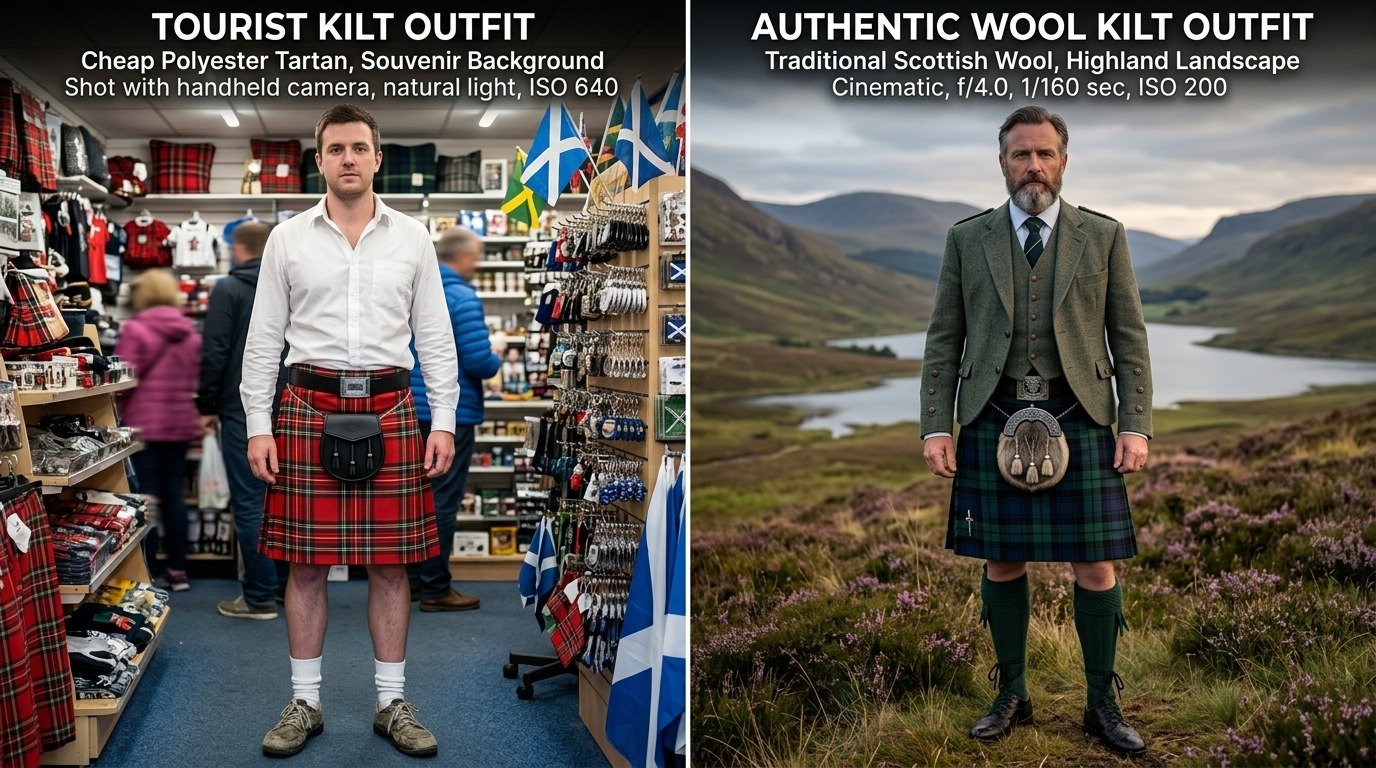
There are two completely different versions of “the kilt” being sold in Scotland right now. The first is the kilt the tourist sees in the shop windows on Edinburgh’s Royal Mile, on the cruise ship souvenir stalls in Inverness, and on the airport gift shelves at Glasgow. Bright tartans, clearly synthetic, stitched cheaply, hung next to “Aye Lassie” tea towels. These are tourist Scotland kilts. They exist to be bought, photographed, worn for one event, and either lost or stuffed in the back of a closet.
The second is the kilt actually worn by Scottish men. By the groom at the Highland wedding. By the father walking his daughter down the aisle. The men playing in the pipe band at the Edinburgh Tattoo. By the regulars at the local Burns Night supper. These kilts cost more, weigh more, look different, and last longer.
If you’re shopping for a kilt — especially online or while visiting Scotland — knowing the difference is the difference between buying something you’ll wear once and buying something you’ll wear for thirty years.
Here’s what separates the two.
The Fabric Test (You Can Feel the Difference Through the Plastic Wrap)
The single biggest separator between tourist kilts and authentic mens kilts is fabric.
Tourist kilts
Tourist kilts are almost always made from polyester-viscose blends, acrylic, or cheap “PV” (polyester-viscose) cloth. The fabric is lightweight to keep manufacturing costs down and easy to dye in bright tartan colors. Held in your hand, it feels slightly slick, has a faint plastic sheen, and bounces back to its original shape almost too quickly. It’s the cloth equivalent of fast fashion.
Authentic kilts
Authentic kilts are woven from pure wool or wool-blend fabric, almost always from one of the historic Scottish mills (Lochcarron, Strathmore, Marton Mills, or House of Edgar are the most common). The fabric has weight to it — a 5-yard kilt in 13oz wool can weigh 3 pounds. It has texture, a slight roughness, and a depth of color you can see in person but rarely in photographs. It moves when you walk, holds creases properly, and ages with character.
The price gap reflects this directly. A tourist polyester kilt costs $40 to $90. A wool kilt from a real Scottish maker starts around $200 and runs to $500 or more for full 8-yard traditional construction.
If a kilt seller can’t tell you the wool weight (typically 11oz, 13oz, or 16oz) and the mill, you’re almost certainly looking at a tourist kilt regardless of how much you’re being charged.
The Pleat Construction Tells the Whole Story
Turn the kilt around and look at the back. This is where the construction quality reveals itself instantly.
Tourist kilts typically have:
- Stitched-down pleats that don’t move freely
- Inconsistent pleat width and depth
- Visible glue or fusing in the pleat folds
- Machine-stitched throughout, often with crooked stitching
- 4 to 6 yards of fabric across all pleats combined
Authentic kilts typically have:
- Hand-stitched pleats that hang freely and swing naturally when walking
- Sharp, identical pleats with consistent depth (usually 0.5 to 0.75 inches each)
- No visible glue or fusing — the pleats are all built from layered fabric
- Hand-stitched waistband and hem; machine-stitched only where reinforcement is needed
- 5 yards minimum, usually 8 yards for fully traditional construction
A 5-yard authentic kilt has roughly 25 to 30 pleats. An 8-yard kilt has 30+ deep pleats that fall in dramatic columns when the wearer walks. A tourist kilt usually has 12 to 18 shallower pleats stitched flatter to save fabric.
The difference is visible from across the room. The authentic pleats sway and move with the wearer. The tourist pleats stay flat and stiff.
The Tartan Selection Difference
Walk into any tourist shop and you’ll see roughly the same six tartans repeated endlessly: Royal Stewart, Black Watch, Pride of Scotland, Scottish National, Caledonia, and one or two clan tartans like MacDonald or MacKenzie.
These are the universally popular tartans that work for any wearer regardless of clan affiliation. There’s nothing wrong with them. But Scottish men shopping for an actual personal kilt are usually looking for something more specific.
What Scottish locals actually choose:
- Their family’s clan tartan, if they have one. Even distant clan affiliations get used as a starting point for kilt selection.
- District tartans representing the area their family is from (Lothian, Argyll, Buchan, etc.)
- Specific commemorative or regimental tartans with personal meaning
- Tartans designed for specific institutions they’re part of — university tartans, professional society tartans, military regimental tartans
The genuine Scotland kilts market is dramatically larger and more nuanced than the dozen tourist options. Real Scottish kilt buyers spend time looking through tartan registries, asking older relatives about clan affiliations, and choosing based on personal heritage rather than visual appeal.
This doesn’t mean tourists are doing it wrong by choosing a popular tartan. It just means the experience of choosing is fundamentally different.
The Length and Fit Truth
This is where most tourist kilts fail spectacularly even when the fabric is acceptable.
Tourist kilts are typically:
- One-size-fits-most with strap adjustments
- Designed to sit at the jeans-line waist (low waist)
- Cut to a standard length with no modifications
- Often too short by 1 to 2 inches because makers reduce length to cut costs
Authentic mens kilts are:
- Sized to the wearer’s specific natural waist measurement (above the navel)
- Cut to fall to the precise center of the kneecap
- Made-to-order or hand-altered to specific body proportions
- Re-tailorable as the wearer’s body changes over the years
The length difference matters more than people realize. A kilt that ends 1 inch above the kneecap looks short and slightly off in every photograph. Kilt that ends 1 inch below the kneecap looks dowdy and old-fashioned. A kilt that ends exactly at the middle of the kneecap looks correct, every time.
Tourist kilts almost never get this right because they’re built to fit a range of bodies, not one specific body.
The Shop Itself Is a Tell
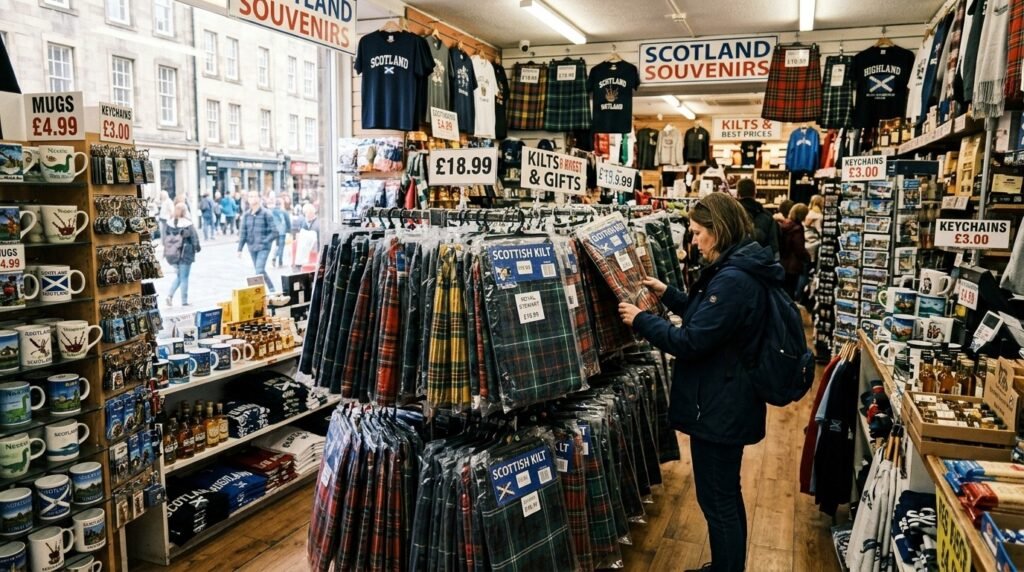
You can usually identify a tourist kilt shop within seconds of walking in. Common signs:
- Pre-packaged kilts in plastic shrink-wrap on shelves
- “We ship worldwide!” signs in the window
- Mannequins in full Highland dress at the front display
- Cheap accessories displayed alongside the kilts (whiskey-themed novelty items, plastic claymores)
- Staff who can’t tell you the mill the wool came from
- Prices that seem unusually low compared to what you’ve researched online
Authentic Scottish kiltmakers, by contrast:
- Are usually quieter, smaller shops
- Have measuring rooms and consultation areas
- Carry fabric swatches rather than finished kilts
- Quote 4 to 8 weeks for proper kilt construction
- Charge in line with the materials and labor involved (typically £200 to £500+ for a full kilt)
The Royal Mile in Edinburgh has both kinds of shops side by side. The price tags and the staff demeanor will tell you everything.
The Accessory Difference
The accessories sold with tourist kilts versus those worn by Scottish locals are also dramatically different.
Tourist kilt accessories:
- Synthetic kilt hose with shiny sheen
- Plastic-fitted sporran with cheap chain
- Stamped-metal kilt pins, often oversized
- Generic black “ghillie-style” shoes that don’t have proper open lacing
- Pre-tied tartan ties
Authentic accessories:
- Pure wool kilt hose with proper turn-down cuffs
- Leather sporrans with hand-finished cantles and quality chains
- Pewter, sterling silver, or hand-finished metal kilt pins
- Real ghillie brogues with leather laces and proper construction
- Tied bow ties or long ties in matched fabrics
A tourist might buy a complete “kilt outfit” for $200 that includes everything. An authentic mens kilts Scotland outfit at the same level of completeness costs $700 to $1,500 — and looks dramatically different in person.
Why This Matters Even If You’re Not Scottish
You might think: “I’m not Scottish, I’m wearing it once for a wedding, the difference doesn’t matter.” It does, for two reasons.
First, the photographs last forever. The wedding ones, the family ones, the dinner ones. Authentic kilts photograph dramatically better than tourist kilts. The wool absorbs light correctly, the pleats catch shadows, the colors read as deep and rich. Tourist kilts under flash photography reveal their plastic sheen instantly.
Second, the cost-per-wear is actually lower for authentic kilts even though the upfront price is higher. A tourist kilt typically gets worn once and then sits unworn — sometimes the wearer is even embarrassed to repeat it after seeing the photos. An authentic kilt becomes part of someone’s wardrobe and gets worn for decades. Cost-per-event is dramatically lower. The “save money on the kilt” decision often costs more in the long run.
Buying Authentic Without Going to Scotland
Most readers won’t be in Edinburgh next weekend. The good news is authentic Scottish kilts can be ordered online from real Scottish kiltmakers and quality international suppliers.
Look for:
- Specified wool weight in product descriptions
- Named mills where the fabric was woven
- Yard count clearly stated (5-yard or 8-yard)
- Hand-stitched details mentioned in construction notes
- Custom sizing as an option, not just S/M/L
- Photographs of pleat detail showing depth and consistency
- Reviews from real wearers discussing weight, drape, and longevity
Anything that doesn’t volunteer this information is probably hiding it for a reason.
Frequently Asked Questions
How can I tell if a kilt is real wool just from photos?
Look for visible texture in the close-up shots. Real wool has a subtle grain. Polyester looks smooth and slightly shiny. Also check the product specs for fabric weight — anything specified in ounces (oz) is usually real wool.
Are all kilts sold in Scotland authentic?
No. Many shops on tourist routes sell the same imported polyester kilts as overseas tourist outlets. Being in Scotland doesn’t guarantee authenticity.
What’s the cheapest authentic kilt I can buy?
Around $200 for a 5-yard wool kilt from a recognized maker. Below that, you’re either getting wool of questionable origin or polyester being marketed as wool.
Can I get an authentic kilt in a non-clan tartan?
Yes. Universal tartans like Black Watch, Royal Stewart, Pride of Scotland, and many district tartans are available in authentic wool construction.
Is a 5-yard kilt good enough or do I need 8?
For most modern wearers, a quality 5-yard wool kilt is excellent. 8-yard is fully traditional and more dramatic but also significantly more expensive and warmer in summer.
How long does a real Scottish kilt take to make?
4 to 8 weeks for hand-finished custom kilts. Pre-made authentic kilts in standard sizes can ship faster.