
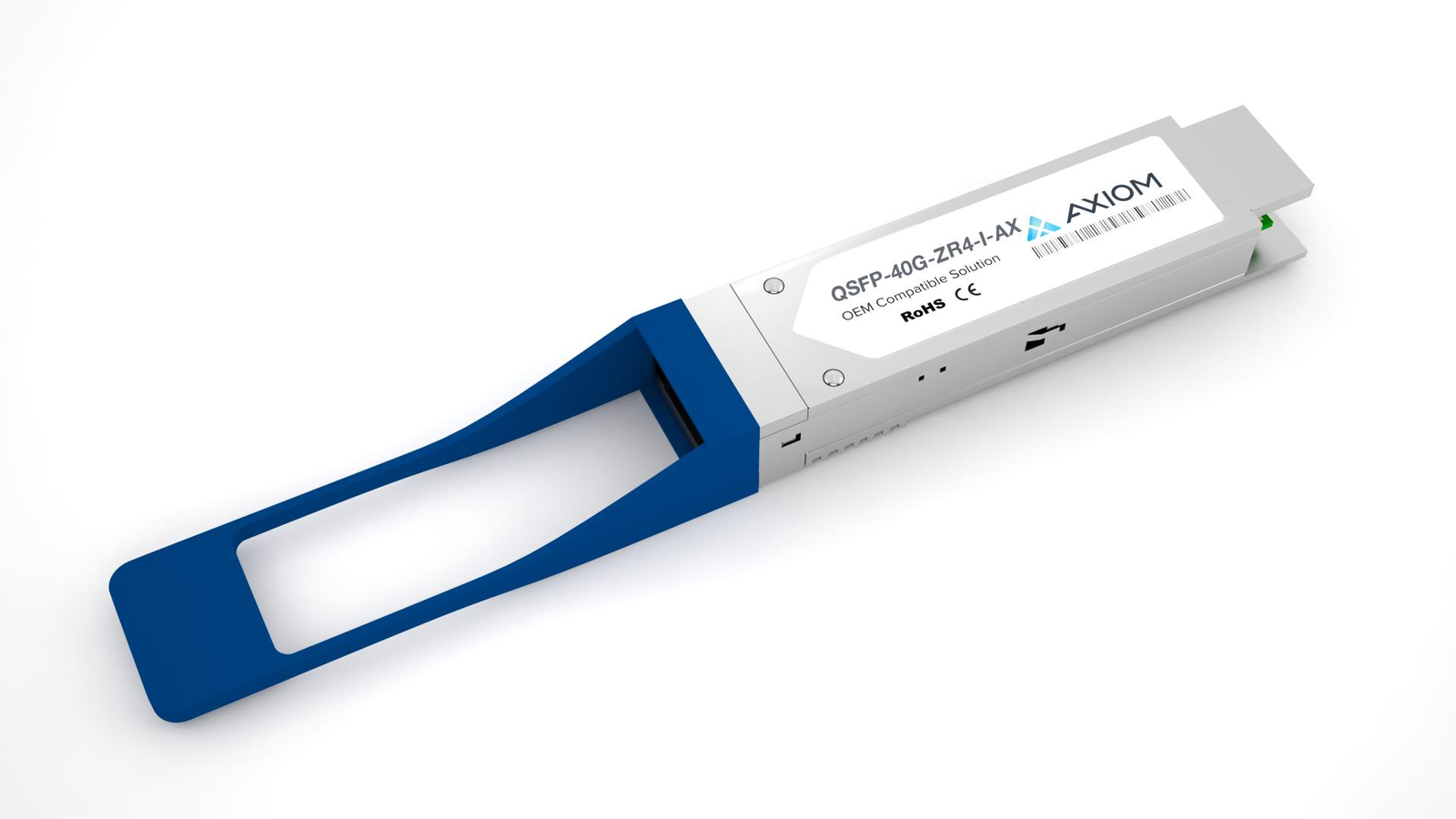
Why 40GBASE-ZR4 Remains Relevant in Existing 40G Networks
Not every network is racing toward 100G or 400G. Plenty of infrastructures still run comfortably at 40G, and in many cases that speed is more than enough. Traffic grows, of course, but growth does not always justify a full platform upgrade. Some systems were designed around 40G years ago and continue to operate reliably today.
In these environments, 40GBASE-ZR4 modules solve a specific problem: extending 40G connections over long distances without redesigning the network.
Upgrading switches, line cards, and monitoring tools can be expensive and disruptive. When the existing architecture works well, replacing it just to gain additional bandwidth is not always practical. Operators often prefer incremental improvements that preserve the original design.
40GBASE-ZR4 fits that approach. It allows networks to stretch beyond local facilities while keeping the same basic interface and operational model.
Sometimes the goal is not modernization but continuity.
Understanding Long-Reach 40GBASE-ZR4 Optical Links
A typical 40GBASE-ZR4 module supports transmission distances up to around 80 kilometers over single-mode fiber. Internally the module uses multiple wavelengths combined into a single fiber pair. From the switch perspective, however, the link behaves like a normal 40G Ethernet connection.
Installation rarely looks complicated. The module is inserted into a QSFP+ port, fiber is connected, and the link usually initializes without extensive configuration.
What changes compared to short-range optics is mainly the optical margin. Long-distance modules operate with tighter budgets, which means fiber quality and connector conditions matter more.
Even so, the technology is well established. Many engineers approach ZR4 deployment with reasonable confidence because the behavior is predictable.
Once the link is stable, it often stays that way.
Why 40GBASE-ZR4 Is Often Used for Inter-Site Connections
Short-distance optics dominate inside data centers, but connecting separate facilities introduces different requirements. Buildings may be separated by several kilometers, and traffic must move reliably between them.
For organizations that standardized on 40G switching, ZR4 modules provide a straightforward interconnection method. Instead of introducing transport equipment, operators can build direct Ethernet links between sites.
This approach keeps the network topology easy to understand. A link between two switches is simply a link, even if the fiber path runs underground across an industrial park or along city infrastructure.
Engineers often appreciate this simplicity. When troubleshooting is necessary, fewer layers of equipment reduce uncertainty.
Some networks start with one long-distance connection and gradually add more. Over time, ZR4 links can form a small backbone tying multiple locations together.
Operational Experience with 40GBASE-ZR4 Deployments
Long-distance optical links behave slightly differently from short connections. Power levels tend to be lower, and small variations are easier to notice.
Monitoring systems often reveal gradual changes that would be invisible on short patch cables. Receive power may shift slightly over months or seasons. These variations are usually harmless, but they give operators a sense that the link is influenced by its environment.
Engineers who manage ZR4 links for a long time become familiar with these patterns. A value that looks unusual to a newcomer may be completely normal.
Routine inspections usually focus on connectors and patch panels. Cleaning and verifying fiber paths helps maintain stable margins. Most problems that appear in long-distance links can be traced back to physical layer issues rather than module failures.
The modules themselves tend to be reliable.
Some installations run for years without requiring replacement optics.
Balancing Cost and Capacity with 40GBASE-ZR4
Network upgrades often involve tradeoffs. Higher speeds promise more capacity but also require new hardware and planning. Staying with existing speeds limits growth but avoids major investments.
40GBASE-ZR4 sits in an interesting position between these choices.
For organizations that already own 40G infrastructure, deploying ZR4 modules extends the life of that investment. Existing switches continue operating, and fiber can be reused.
The cost difference compared to full platform upgrades can be significant. Budget constraints sometimes make incremental improvements the only realistic option.
In practice, many networks operate comfortably at 40G for longer than originally expected. Traffic forecasts may predict rapid growth, yet actual demand increases more slowly.
ZR4 modules allow networks to adapt without committing to immediate large-scale changes.
Fiber Infrastructure and 40GBASE-ZR4 Planning
Fiber availability influences deployment decisions.
If dedicated single-mode fiber pairs exist between locations, installing ZR4 links is relatively simple. The optical design remains straightforward, and troubleshooting paths are clear.
Limited fiber resources create different challenges. Sharing infrastructure with other services may require coordination. Planning becomes more careful because spare capacity is limited.
Still, direct Ethernet links often remain attractive because they avoid additional layers of optical multiplexing equipment.
The simplicity of a point-to-point fiber path has practical advantages, especially for smaller networks.
Engineers often prefer solutions they can fully understand and control.
Long-Term Behavior of 40GBASE-ZR4 Links
One characteristic of mature networks is stability. After the initial deployment phase ends, changes become less frequent.
40GBASE-ZR4 links often settle into this stable phase. Traffic patterns may evolve, but the optical connections themselves remain unchanged.
Over time these links become part of the background infrastructure. Monitoring systems continue collecting data, yet operators rarely need to intervene.
Occasionally a connector must be replaced or a fiber segment repaired. Outside of these events, the links tend to operate quietly.
Some organizations continue running 40G ZR4 connections long after newer technologies become available. Replacement happens only when capacity limits are reached or hardware ages out.
Until then, the existing links continue serving their purpose.
Future Transitions Beyond 40GBASE-ZR4
Eventually, most networks move beyond 40G. Equipment lifecycles end, and bandwidth requirements increase.
When upgrades begin, ZR4 links often remain in service during transition periods. New higher-speed connections are added gradually while older links continue carrying traffic.
This coexistence allows operators to migrate services carefully instead of rushing large changes.
ZR4 modules provide stability during these transitions. Even as new technologies appear, the existing long-distance links continue operating.
In many cases, they remain useful longer than expected.
Conclusion
40GBASE-ZR4 modules provide a practical solution for extending 40G Ethernet across long distances. They support stable inter-site connections while preserving existing infrastructure and operational practices. Although higher-speed technologies continue to evolve, many networks still depend on reliable 40G links. In these environments, 40GBASE-ZR4 offers a balanced approach that combines familiar deployment methods with the reach needed to connect distant locations.