
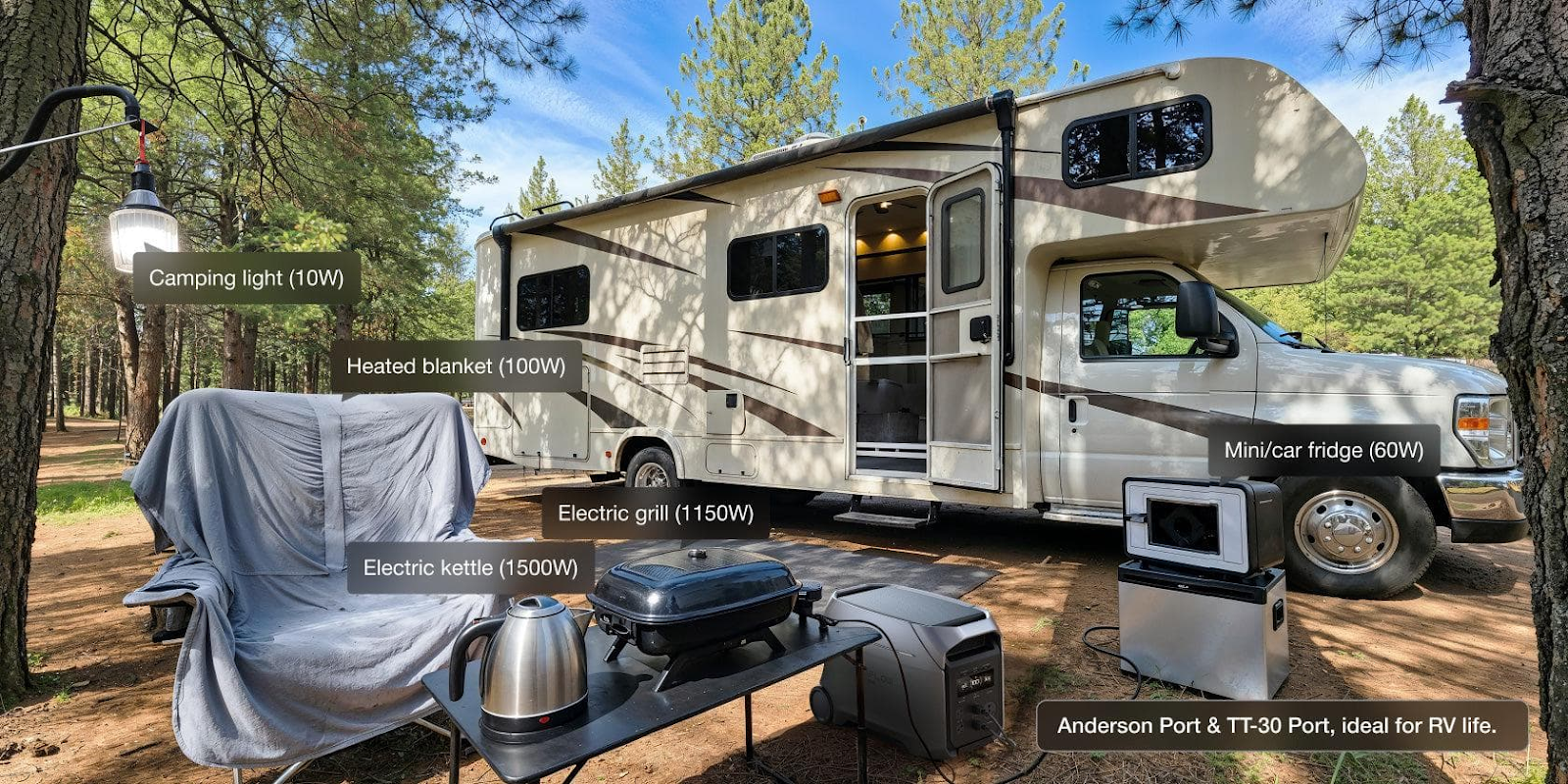
When choosing a power station for camping, the most important specification is battery capacity, measured in watt-hours (Wh), because it determines how long your gear can run. The second key spec is output power, measured in watts (W), because it determines what devices you can run at all.
In simple terms:
Wh is your fuel tank. W is your engine power.
This guide helps you quickly determine how many Wh you need for camping, explains how to estimate real-world daily power usage, shows when solar charging makes sense, and helps you avoid buying a unit that looks good on paper but underperforms in practice.
Why Wh Matters More Than You Think for Camping
Many first-time buyers focus on the number of outlets, peak wattage, or claims like “can run a kettle.” In real camping scenarios, however, battery capacity is almost always the limiting factor, not peak power.
Most camping setups require steady, low-to-moderate power over long periods: phones, lights, fans, cameras, and sometimes a cooler. If Wh capacity is too small, even a powerful unit will drain quickly.
A smarter approach is to choose a power station that balances usable Wh, weight, charging speed, and ports, rather than chasing maximum wattage.
Quick Answer: Recommended Wh Ranges for Camping
If you want a fast decision framework, use these ranges.
200–300Wh is suitable for minimalist or short overnight trips.
This capacity works for phones, headlamps, LED lights, and small accessories. It is enough if you are not running a fan all night or using a powered cooler, but there is little margin.
500–700Wh is the most common and stress-free camping sweet spot.
It comfortably supports multiple devices, overnight fan use, and battery charging for cameras or drones. In some cases, it can even handle a small cooler with careful usage.
1000Wh and above is best for multi-day trips, family camping, or reliable cooler use.
Larger capacity provides a buffer for cloudy weather, extra users, or longer stays.
More capacity also means more weight and higher cost. If you camp infrequently or need to carry the unit far from your vehicle, an oversized power station may end up staying at home.
How to Estimate Your Daily Camping Power Needs
The basic calculation is straightforward:
Power (W) × Time (hours) = Energy (Wh)
Below are realistic planning examples.
A typical smartphone battery is around 10–15Wh. Accounting for charging losses, one full charge usually consumes about 15–20Wh.
Two phones charged twice per day use roughly 70Wh.
LED camping lights usually draw between 5 and 20W.
A 10W light used for five hours consumes about 50Wh.
Camping fans vary widely, commonly between 10 and 40W.
A 20W fan running for eight hours overnight uses about 160Wh.
Laptop charging typically draws 40–100W.
Charging at 60W for two hours requires roughly 120Wh.
Portable fridges and coolers are often underestimated.
Although compressor coolers may draw 40–60W while running, they cycle on and off. A more realistic planning method is to estimate average power, often 30–40W.
At 35W over 24 hours, daily consumption approaches 840Wh, which explains why cooler users often need 1000Wh or solar support.
Devices That Small Power Stations Should Avoid
Even if a power station can technically supply high wattage, high-heat appliances are impractical for camping.
Electric kettles, hair dryers, and space heaters often draw 1000–1800W, draining batteries rapidly and triggering loud cooling fans or overload protection.
Camping power stations are best suited for long-duration, low-to-moderate loads, not short bursts of extreme power.
Estimating Real Usable Capacity and Runtime
You will not be able to use 100 percent of the rated Wh due to conversion losses.
If most of your usage is USB or 12V DC, assume rated Wh × 0.9.
If you rely heavily on AC outlets, use rated Wh × 0.8.
Runtime can be estimated as:
Usable Wh ÷ Device Power (W) = Runtime (hours)
For example, a 600Wh power station used mostly via AC has about 480Wh usable.
Running a 40W fan would provide roughly 12 hours of operation.
Why DC and USB Outputs Last Longer Than AC
Powering devices through USB-C, USB-A, or 12V DC is generally more efficient than using AC outlets.
AC power requires inverter conversion, which introduces additional losses.
Whenever possible, using DC or USB outputs will noticeably extend runtime.
Real-World Factors That Reduce Runtime
Cold temperatures reduce battery efficiency.
Frequent fan operation and leaving the power station switched on with small loads also increase energy loss through standby drain.
These effects are normal and should be factored into planning.
Important Camping Features Beyond Wh
Portability matters more than many people expect.
For car camping, weight is less critical. For longer carries, a lighter unit with sufficient capacity often provides a better overall experience.
Noise is another key factor, especially at night.
Some power stations run fans aggressively even at low loads, which can disrupt sleep.
A camping-friendly power station typically includes USB-C PD (ideally 100W), multiple USB-A ports, at least one AC outlet, and optionally a 12V output for vehicle accessories.
Solar Charging for Camping
Solar panels can turn a one-night battery into a multi-day system when properly matched.
A 100W panel works for topping up phones and small electronics.
A 200W setup is more realistic for weekend camping.
For continuous cooler use, 400W or more of solar input may be necessary.
Actual solar output varies widely due to angle, clouds, and heat, so nameplate wattage should not be treated as constant.
Choosing by Camping Style
Minimalist campers using phones and lights can rely on 200–300Wh.
Weekend campers running fans and charging multiple devices are best served by 500–700Wh.
Family campers or anyone running a fridge will appreciate 1000Wh or more.
Backpacking favors lower Wh and lighter weight, while car camping allows larger capacity in exchange for comfort.
Conclusion
The best camping power station is not the biggest one available.
It is the unit that matches your daily Wh needs, trip length, and willingness to carry weight.
As a quick rule of thumb:
200–300Wh works for minimalist charging,
500–700Wh is the most common weekend sweet spot,
and 1000Wh or more makes multi-day camping and cooler use far easier, especially when paired with solar.
Disclaimer
This article is provided for general informational and educational purposes only. Power consumption estimates, watt-hour (Wh) recommendations, and runtime calculations are based on typical usage scenarios and common device specifications. Actual performance may vary depending on specific equipment, environmental conditions, battery age, charging efficiency, inverter losses, and individual usage habits.
This guide does not constitute professional, electrical, or engineering advice. Readers should always consult manufacturer specifications, safety guidelines, and product manuals before purchasing or operating any power station, solar panel, or electrical device.